For centuries, the art of outdoor surveying was a battle against scale. The vastness of a proposed highway, the sprawling topology of a new development, or the sheer depth of a quarry presented a fundamental challenge: how do you accurately measure something that is, by its very nature, too big to hold?
Traditional methods were a testament to human ingenuity, but also to human limitation. The surveyor with a theodolite and a measuring chain was a master of geometry and grit. Yet, their work was slow, laborious, and susceptible to a cascade of errors. A single misstep across a ravine, a sag in the chain over a long distance, or an optical illusion in a desert heat shimmer could introduce inaccuracies that would multiply over a project. Surveying, in this sense, was a constant struggle to defy the distance that stood between the measurer and the measured.
The very act of traversing difficult terrain to take a measurement meant that the process was physically demanding and often dangerous. Swamps had to be waded, cliffs had to be scaled, and long, straight lines had to be cleared through dense undergrowth, not for a road, but just to create a path for the tape. The distance itself was the enemy.
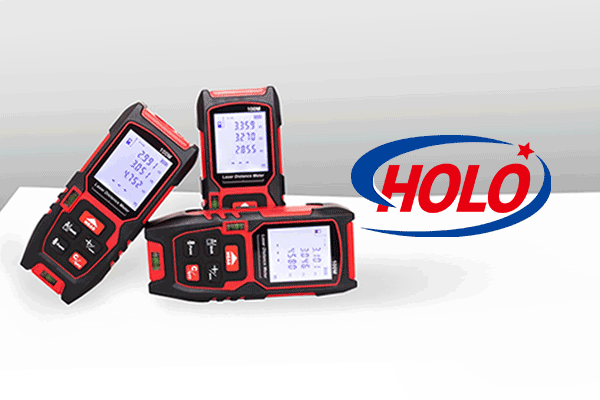
Then came the laser. This concentrated beam of light, coherent and pure, became the surveyor’s ultimate weapon against the tyranny of space. The handheld Laser Distance Meter (LDM) didn’t just improve the old methods; it fundamentally rewrote the rules of engagement with the outdoor environment. It brought precision along for the ride, packing it neatly into a rugged, portable device.
Now, to “defy distance” has taken on a new meaning. The surveyor no longer needs to physically conquer the space between Point A and Point B. The laser does the traveling at the speed of light. Standing at a property corner, the surveyer can instantly and accurately determine the distance to a point across a river, to the top of a silo, or to the far end of a planned parking lot. The physical obstacles that once defined the job—the ravine, the traffic, the vegetation—become irrelevant. The distance is measured optically, not physically.
The precision that the LDM brings along is transformative. We are no longer speaking of measurements within a few inches over hundreds of feet, but within fractions of an inch. This isn’t just about convenience; it’s about the integrity of the entire built world. When a highway interchange is laid out, a fraction of a degree of error in an angle or a few centimeters of error in a distance can result in ramps that don’t meet, bridge supports that are misaligned, or drainage systems that fail. The laser’s precision ensures that the grand designs on an architect’s screen translate perfectly into the physical reality of the landscape.
Furthermore, this marriage of defiance and precision streamlines the entire workflow. A single person with an LDM can accomplish in minutes what once took a team hours. This data, captured digitally and with high accuracy, can be instantly integrated into CAD software, GIS databases, and 3D modeling programs. The physical act of measuring becomes a seamless digital handoff, reducing transcription errors and accelerating project timelines. The surveyor is freed from the drudgery of manual recording and can focus on the more complex analytical aspects of their job.
Outdoor surveying will always be a dance with distance. The world is vast, and our need to define, divide, and develop it is constant. But the tools we use for that dance have evolved. With the Laser Distance Meter in hand, the surveyor no longer struggles against the expanse. Instead, they command it. They project a beam of pure light across the void, and in the instant it returns, they have captured the truth of the space, transforming the boundless into the measurable with unwavering precision.