
In a world where accuracy defines progress, measurement has always been the silent foundation of creation. From building skyscrapers to hanging a picture frame, every great achievement begins with getting the numbers right. Yet traditional measuring tools—tape measures, rulers, yardsticks—have long carried inherent limitations: they bend, break, require two people for long distances, and struggle in complex spaces. Enter the smart laser measuring tool: a device that replaces physical constraints with the speed of light, and redefines what precision means in the modern age.
The Evolution of a Simple Idea
The concept of using light to measure distance isn’t new—surveyors and engineers have used laser technology for decades. But recent advancements in miniaturization, digital displays, Bluetooth connectivity, and onboard intelligence have transformed bulky industrial tools into pocket-sized marvels. Today’s smart laser measures are designed for everyone: contractors, interior designers, DIY homeowners, real estate agents, and artists.
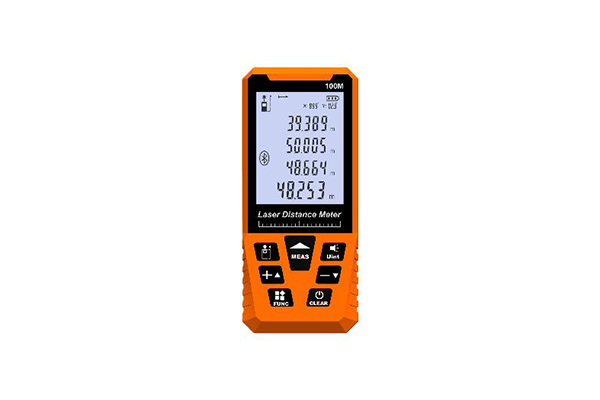
At their core, these tools emit a laser pulse toward a target surface and calculate distance by measuring the time it takes for the reflection to return. That process—known as time-of-flight or phase-shift measurement—yields results accurate to within ±1/16 of an inch (or even ±1/32 on premium models), over distances up to 200 or even 400 feet.
Breaking the Physical Chain
The most obvious limitation of a tape measure is length. Beyond 25 or 50 feet, tapes become unwieldy, sag under their own weight, and require two people to hold tension. Laser tools eliminate this entirely. One person, one button, one reading—instantly.
Even more liberating is the ability to measure inaccessible spaces. Need the height of a cathedral ceiling? The distance from a window to the opposite curb? The diagonal of a room for flooring? Simply aim, click, and read. No climbing ladders, no reaching around corners, no guesswork.
Smart Features That Matter
What makes these tools “smart” goes far beyond basic distance readings. Modern laser measures integrate features that actively assist in planning and execution:
● Area and volume calculation – Measure length and width, and the tool automatically computes square footage. Add height, and it calculates cubic volume for paint, concrete, or HVAC planning.
● Indirect (Pythagorean) measurement – Measure a height by taking two or three readings from ground level, using trigonometry. Ideal for roof peaks or tall walls.
● Continuous measurement mode – Move the tool along a wall, and the display updates in real time, functioning like an intelligent electronic tape.
● Digital level and angle finder – Integrated inclinometers help align shelves, verify studs, or check slopes.
● Bluetooth and data storage – Save measurements to onboard memory or transmit them directly to smartphone apps, tablets, or construction software. No more messy notebooks or transcription errors.
● Live viewfinder or camera targeting – On premium models, a built-in camera shows exactly where the laser is aimed—critical for outdoor use in bright sunlight.
Real-World Applications Without Boundaries
The phrase “without boundaries” is not marketing hyperbole. Consider these scenarios:
● Construction and renovation – Measure entire floor plans alone, verify drywall cuts, or calculate material orders without moving furniture.
● Real estate – Generate room-by-room square footage for listings in minutes, not hours.
● Interior design – Confirm furniture dimensions against wall spaces from across the room, without dragging a tape across client floors.
● Industrial maintenance – Measure pipe spans, conveyor lengths, or overhead clearances from a safe ground position.
● Home DIY – Hang gallery walls perfectly spaced, center light fixtures, or measure for blinds and curtains without risk of tape recoil.
Precision as a Promise, Not a Compromise
Accuracy is the non-negotiable core. Smart laser tools are calibrated to strict standards, often including self-calibration alerts. Many models display measurements to 1/16 inch or 0.001 meters, and premium devices offer fractional readouts to eliminate decimal confusion. The laser itself is typically Class II (<1mW), safe for everyday use under standard safety guidelines.
Battery life has also matured—many units run for 5,000+ measurements on a single charge or set of AAA batteries. Durability features like IP54 water and dust resistance, rubberized bumpers, and drop protection mean these tools survive job site realities.
The Human Benefit: Confidence and Speed
Beyond specifications, the real value of a smart laser measure is psychological. When you know your measurement is accurate to the millimeter, you cut once without hesitation. When you can measure alone without awkward contortions, you work faster. When your data transfers directly to a spreadsheet or blueprint, you eliminate the single largest source of construction error: manual recording.
Choosing Your Light Ruler
Entry-level models (under $50) offer basic distance and area measurement, perfect for home use. Mid-range tools ($50–$150) add Pythagorean mode, backlit displays, and data memory. Professional-grade devices ($150–$500) include viewfinders, longer range (300+ ft), higher precision (±1/32 inch), Bluetooth, and integration with BIM (Building Information Modeling) software.
For most users, a mid-range tool from a reputable brand—Bosch, Leica, DeWalt, Klein Tools, or HILTI—represents the ideal balance of price, durability, and functionality.
Looking Ahead
The next generation of smart laser tools will include augmented reality overlays, voice-activated measurement, and seamless cloud sync. Some prototypes already project measurement lines directly onto surfaces or integrate with robotic total stations for fully automated layout.
But even today’s models fulfill a simple, powerful promise: that light, traveling at 299,792,458 meters per second, can become the most practical ruler you’ll ever hold.
Conclusion
“Light as a Ruler, Precision Without Boundaries” is not just a tagline—it’s a technical reality. Smart laser measuring tools have freed us from the physical limits of tapes and sticks, empowering anyone to measure quickly, accurately, and confidently in any environment. Whether you are framing a house, planning a renovation, or simply hanging a shelf, the right measurement is always just a click away. And with light as your guide, the only limit left is your imagination.