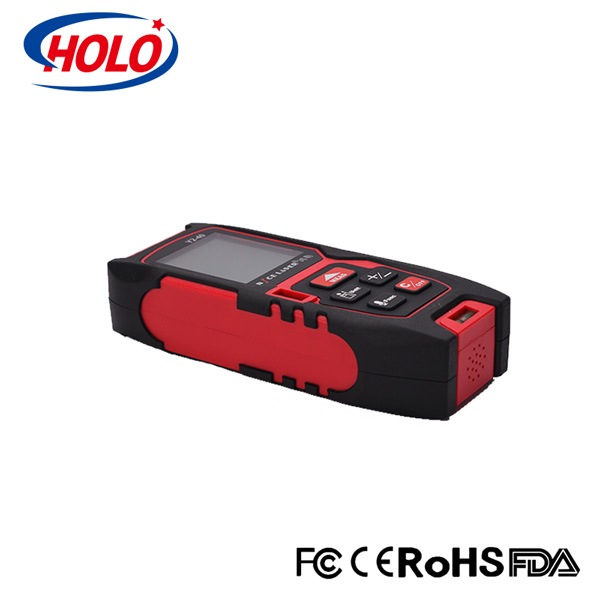
In professional scenarios such as engineering surveying and mapping, building construction, and equipment installation, we often face the dilemma of being unable to directly measure the distance to a target: a connecting line between two points blocked by obstacles, the vertical height of an overhead suspended object, the diagonal distance across complex terrain, and so on. In such cases, traditional tape measures or ordinary distance measuring tools are often ineffective. The combination of the Pythagorean theorem and modern laser distance meter has become a core solution for professionals to overcome the limitations of measurement. This is not only an innovative application of classic geometric principles, but also a concentrated embodiment of the advanced functions of distance measuring equipment, providing an efficient and reliable new approach to precise measurement.
I. Why do professional scenarios require the “indirect distance measurement” function?
The core demands of professional measurement are precision and efficiency, yet real-world scenarios are fraught with constraints: during bridge maintenance, it is impossible to climb directly to the top of a pier to measure diagonal distances; in interior decoration, the diagonal span of ceiling keels is blocked by furniture or walls; in electric power construction, it is necessary to measure the horizontal spacing between two overhead cables but physical close contact is not feasible. In these scenarios, direct measurement is not only extremely difficult to operate and accompanied by high safety risks, but may also lead to distorted data due to deviations in the measuring path.
Advanced laser distance meters with integrated Pythagorean theorem functionality perfectly resolve this pain point through the logic of “two sides measured, the third side calculated”. Their core advantages are: no need for physical contact with the target, immunity to obstacle interference, and millimeter-level measurement accuracy—fully meeting the stringent requirements of professional scenarios such as project acceptance and precision installation, and making indirect distance measurement as simple as direct measurement.
II. Pythagorean Theorem + Laser Distance Meter: Core Logic and Operational Breakdown of Advanced Functions
The core of the Pythagorean theorem is $a^2+b^2=c^2$ (in a right triangle, the square of the hypotenuse is equal to the sum of the squares of the two right sides). Advanced laser distance meters are built with this algorithm, which converts the measured data of two right sides into the target hypotenuse distance, or calculates the length of the remaining right side (e.g., vertical height, horizontal distance) from the hypotenuse and one known right side. Its operational logic can be divided into three core application scenarios, each reflecting the professional design of the product:
1. Scenario 1: Measuring vertical height of overhead objects (e.g., pendant lamp height, floor-to-ceiling distance)
Operation Steps:
① Activate the Pythagorean Mode (Vertical) on the distance meter;
② Hold the device horizontally, aim at the bottom of the target (e.g., the ground), and measure the first right side (vertical distance from the device to the ground, pre-settable as the device’s own height);
③ Keep the device horizontal, aim at the top of the target (e.g., the pendant lamp), and measure the second right side (horizontal distance from the device to the target top);
④ The device automatically calculates the hypotenuse length, i.e., the vertical height of the target.
Core Advantages: No ladders or elevated work are required, eliminating the risks of aerial operations. The measurement accuracy reaches ±2 mm, far exceeding the error margin of traditional tape measures (usually ±5 mm or more). This mode is ideal for scenarios requiring precise height data, such as hotel renovation, stage construction and air conditioning installation.
2. Scenario 2: Measuring distance between two blocked points (e.g., diagonal distance across both sides of a wall, distance between two river banks)
Operation Steps:
① Switch to the Pythagorean Mode (Horizontal);
② Select Point A on one side of the obstacle, and measure the horizontal distance from Point A to the obstacle edge (Point B) as the first right side $a$;
③ Move to Point C on the other side of the obstacle, and measure the horizontal distance from Point C to the obstacle edge (Point B) as the second right side $b$;
④ The device automatically calculates the straight-line distance between Point A and Point C ($c=\sqrt{a^2+b^2}$).
Core Advantages: No need to bypass obstacles, saving measurement time—especially for long-distance scenarios such as diagonal measurement in factory workshops. The device also supports data storage and export, which can be directly synced to CAD drawing software to improve work efficiency. This function is particularly suitable for architects and engineers conducting on-site surveys.
3. Scenario 3: Measuring the actual length of inclined objects (e.g., slope length, roof inclined span)
Operation Steps:
① Enable the Pythagorean Mode (Inclined);
② Measure the horizontal projection distance of the inclined object as the first right side $a$;
③ Measure the vertical height difference of the inclined object as the second right side $b$;
④ The device automatically calculates the actual length of the inclined object (hypotenuse $c$) and displays the tilt angle simultaneously (e.g., 30°, 45°).
Core Advantages: It not only provides length data, but also outputs angle information synchronously, meeting professional needs such as building structure calculation and road construction. For example, when laying waterproof materials on a roof, the material consumption needs to be calculated based on the inclined surface length and angle, and the integrated data output of the distance meter can be directly applied to construction plans.
III. Essential for Professional Users: “Hidden Advantages” of Advanced Laser Distance Meters to Maximize Measurement Value
Beyond the core Pythagorean theorem-based functions, professional-grade laser distance meters are equipped with the following value-added design features that perfectly align with the work habits of professional users:
1. Precision Guarantee: Adopting laser phase-shift measurement technology combined with temperature compensation algorithms, it maintains an accuracy of ±2 mm even in extreme ambient temperatures ranging from -10℃ to 60℃, eliminating errors caused by environmental factors.
2. Battery Life & Durability: Supporting Type-C fast charging, a full charge enables more than 5,000 consecutive measurements. The body is designed with IP54 dust and water resistance, suitable for complex scenarios such as construction sites and outdoor operations.
3. Intelligent Interactive Functions: Equipped with an OLED high-definition luminous display (visible at night) and voice broadcast of measurement results; it also supports Bluetooth connection to mobile phone apps for real-time data sharing and report generation, facilitating team collaboration.
4. Multi-unit Switching: Compatible with three units (metre, foot, inch), meeting the standard requirements of domestic and international projects.
IV. Real Cases: From Theory to Practice, Authentic Feedback from Professional Users
Mr. Zhang, an engineer at a architectural design institute, shared his experience: “During the on-site survey of a commercial complex, we needed to measure the diagonal distance of the atrium’s open floor area (approximately 25 meters), which was blocked by sightseeing elevators and greenery—making direct measurement impossible. Using the Pythagorean mode of this distance meter, we completed the measurement in just 3 minutes with a data error of only 0.8 mm, which perfectly matched the theoretical value of the subsequent CAD modeling. Compared with the traditional method (erecting scaffolding and pulling steel tape measures), we saved 2 hours of construction time and eliminated the safety risks of aerial work.”*
Master Li, a construction worker at a power company, commented: “In the past, measuring the horizontal spacing of high-voltage cables relied solely on visual estimation with large errors. Now, with the vertical mode of the distance meter, we can accurately measure the height difference and horizontal distance between two cables from the ground, and calculate the actual spacing to ensure compliance with safety specifications for construction. The professional functions of this device have improved our work efficiency by at least 50%.”